
The Reader and His Audiences
News of the WorldThis thread traces how local audiences use Kidd’s readings to encounter distant worlds, while their reactions reveal their own anxieties and divisions.
increasing Bearing strength in each event
 decreasing
Bearing strength in each eventdecreasingA Crowd for the Amendment
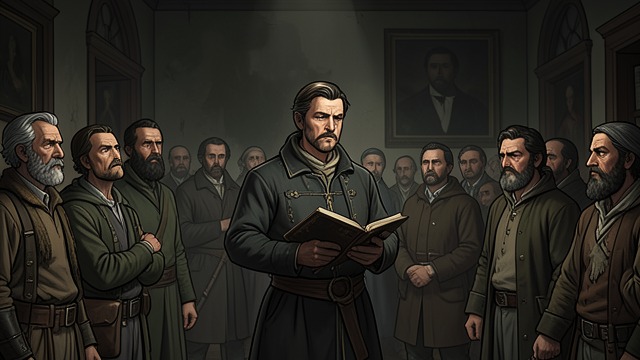
A Crowd for the Amendment
A charged audience
Kidd’s report on the Fifteenth Amendment provokes muttering in a hall filled mostly with white men. The crowd’s reaction makes clear that news can unsettle the audience it informs.
The reader’s authority
Kidd tells the listeners to stop muttering and hear the report. His role depends on commanding attention while exposing the audience to facts it may resist.
The Hansa Story

The Hansa Story
A remote disaster
Kidd reports that the Hansa has been crushed in Arctic ice and initially notes that survivors are not mentioned. The audience hears about a distant expedition through the reader’s careful presentation.
News becomes narrative
The story gives listeners a perilous world beyond their immediate region. Later reports of rescue demonstrate how new information can revise the emotional shape of a story.
The Polar Rescue

The Polar Rescue
The report changes
Kidd reads that survivors from the Hansa have been rescued by a whaler. The audience leans forward to hear about ice kingdoms, danger, and people traveling through an unknown world.
Suspense shared collectively
The listeners’ attention shows how public reading can create a communal emotional experience. They do not simply receive a fact; they follow the event as a story with a changed outcome.
The Skating Article

The Skating Article
A deliberate choice
Kidd selects a light report about women skating on ice in Philadelphia, hoping for a calm subject amid local political conflict. The article describes a world far from the contested Texas roads.
The audience’s imagined safety
Its image of firm ice and leisurely recreation offers a contrast to the dangers surrounding the travelers. Kidd uses selection as part of his craft, shaping an interval of relative calm.
The Audience Laughs

The Audience Laughs
Shared response
Kidd reads unusual reports and comic details while Cicada sits near the door. She laughs when the audience laughs, joining a public response whose language she has gradually learned.
A temporary community
The shared laughter briefly connects listeners who otherwise live among conflict and uncertainty. Kidd’s reading becomes a space where attention and emotion can circulate safely for a short time.
Winter 1870, Wichita Falls
Winter 1870, during the Wichita Falls reading
March 1870, during the Dallas reading
March 1870, while Kidd prepares a Durand program
During the later readings with Cicada
